




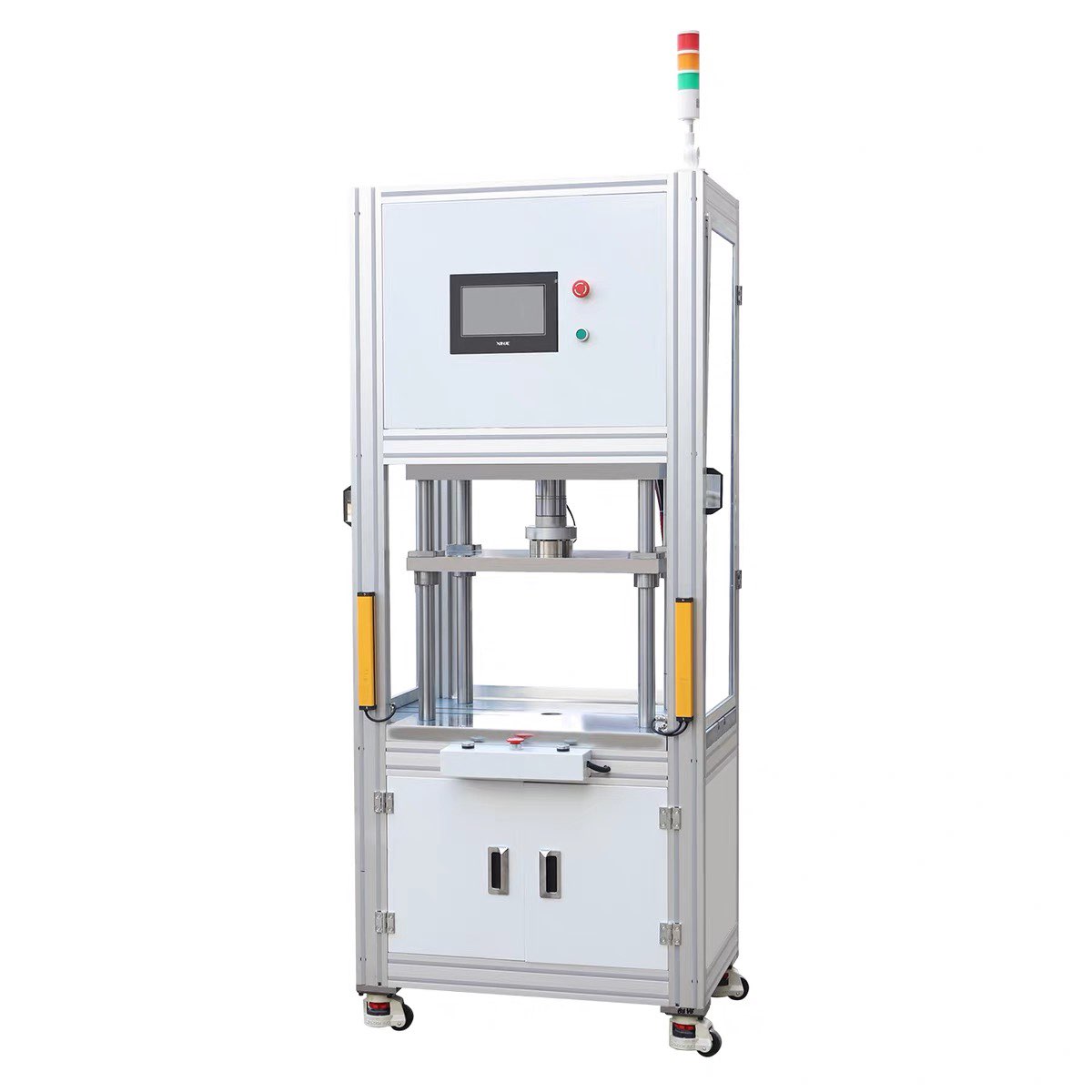
PUMO servo press - working principle and analysis of force displacement closed-loop control
The core working principle of PUMO servo press is "servo motor drive+ball screw transmission+force displacement dual closed-loop feedback". Its essence is to precisely control the output size, action position, and action speed of mechanical energy using electrical signals, rather than relying on fluid pressure or mechanical dead stop blocks to passively limit the stroke of traditional presses. The work cycle begins when the operator or automation system triggers a start signal (two hand button/PLC peripheral I/O/robot DO). The PUMO control system retrieves the currently activated press fit recipe and commands the servo drive to output a three-phase AC current drive servo motor with corresponding frequency and voltage/current according to the preset speed curve; The output shaft of the servo motor drives the high-precision ball screw to rotate through a coupling or synchronous belt reduction mechanism. The screw nut is constrained by the slider/head mounting plate to convert the rotational motion into a vertical downward linear motion, and the head approaches the workpiece at the set speed.
When the pressure head contacts the workpiece, the pressure resistance begins to rise. The front-end high-sensitivity piezoelectric force sensor (strain gauge or piezoelectric quartz type, with a range covering 10% to 100% FS of the rated force and an accuracy of ± 0.5% FS or better) detects small changes in force and feeds back analog (mV/V) or digital signals to the A/D module of the control system; At the same time, the absolute value/incremental encoder (17bit/23bit resolution) at the end of the servo motor shaft or screw continuously feeds back the motor angle, and the real-time displacement of the pressure head is calculated (with a resolution of up to 0.001mm). The control system compares the measured force F_act, displacement s_act with the target force F_set, target displacement s_set, and upper and lower limits of the allowable window set in the formula at millisecond intervals - this is the unique force displacement dual closed loop monitoring mechanism of PUMO servo press.
Based on this mechanism, PUMO supports four core press fit control modes: ① Positional Stop - a termination condition when the press head reaches the preset depth S2set, commonly used for interference fit press fit (such as bearing pressure entering the journal), ensuring fit quality by accurately controlling the press fit depth; ② Force Stop - with the detection of the pressing force reaching F_set as the termination condition and switching to holding pressure, commonly used in riveting, lining pressing, or processes that require constant force fitting; ③ Mixed mode (Position → Force Switch) - First, control the pressure to a certain depth through position control (preloading/centering), and then switch to force control to maintain the specified pressure value for a period of time (such as confirming the interference fit by holding the pressure for 3 seconds after the bearing pressure is installed in place). This is the most typical precision pressing strategy; ④ Free programming multi-stage mode - divides a single trip into a fast forward section (Rapid Approach, high-speed low force time-saving), a detection section (Search/Low Speed, low-speed sensing contact point collision avoidance), a pressing section (Pressing, precise low-speed ensuring curve quality), a buffering section (Deceleration), a holding section (Dwell/Cold), and a return section (Return), with independent speed/force/position parameters set for each section.
During the pressing process, the control system continuously traces points and draws an F-S curve (the horizontal axis represents the pressing depth, and the vertical axis represents the real-time pressing force). Typical characteristic points include: contact point (Curve Start/Touch Point), pressing slope (Curve Slope/K value), peak force (Peak Force), and end position (End Position). Users can set 1-5 judgment windows (Window/Slope) on the curve. Only when the actual curve falls within the qualified envelope area and the peak force and endpoint position are within the allowable tolerance range, will it be judged as OK. Otherwise, it will be judged as NG and the failure type will be recorded (such as early contact - burrs or foreign objects; abnormal slope - part size exceeding tolerance; overvoltage - excessive interference; undervoltage - not pressed in place, etc.), providing detailed basis for process analysis. The Force Displacement Evaluation function is the most important distinguishing feature of PUMO servo presses from ordinary position controlled or force controlled single machines, and it is also the core of error prevention to achieve "no manufacturing defects, no flow of defects". Some high-end models can also perform force time (FT) monitoring and displacement time (ST) monitoring, and support second-order derivative (curvature/inflection point) detection for identifying stuck or sudden release (Snap through) phenomena, especially suitable for elastic pins, snap springs, and press fit processes with obvious yield points.