




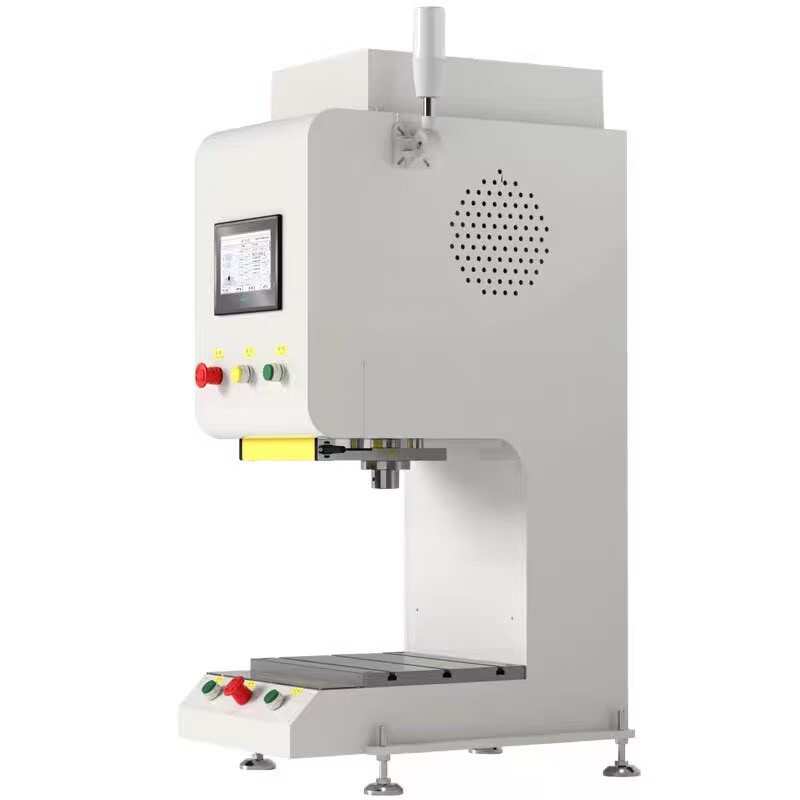
PUMO servo press - C-type/four column/desktop three major structural forms and application matching
PUMO servo presses are mainly divided into three types based on their body structure: C-type (single column bow), four column type (four guide column frame), and desktop mini type. They are designed for different workpiece sizes, pressing accuracy, and production line layout requirements:
1、 C-Frame/Open Gap Type servo press
Structural features: The overall opening is in the shape of a "C", with the front, left, and right sides open in three directions. The throat depth (Throat Depth=distance from the centerline of the spindle to the inside of the C-shaped column) is usually in several levels of 120mm, 160mm, 200mm, 250mm, and 300mm. The back of the column is enclosed to provide rigid support, and the open working area between the workbench and the machine head is convenient for manual loading and unloading or docking with Cartesian coordinate robots/SCARA robots. The stroke of the pressure head is generally 50-300mm, and the opening height (Daylight/Max Stroke+Die Height) is adjustable from 150-500mm (through limit or mechanical stop). Advantages: Good operational visibility, convenient loading and unloading, small footprint, low cost, easy fixture replacement; Disadvantage: When the throat is subjected to eccentric loads, there is a slight opening gap deflection in the body, which is sensitive to ultra large circumferential eccentric loads. Applicable: Single point concentrated load processes such as bearing pressing into shafts/holes, bushing pressing, pin shaft assembly, terminal crimping, small riveting, button fitting, etc. The rated force is mostly concentrated in 0.5-100kN (0.05-10tf). The PUMO C-series offers two installation forms: tabletop (with adjustable foot screws, placed on the side table of the assembly line) and floor standing (with base foot holes that need to be fixed with foot bolts).
2、 Four Column/H Frame Type Servo Press
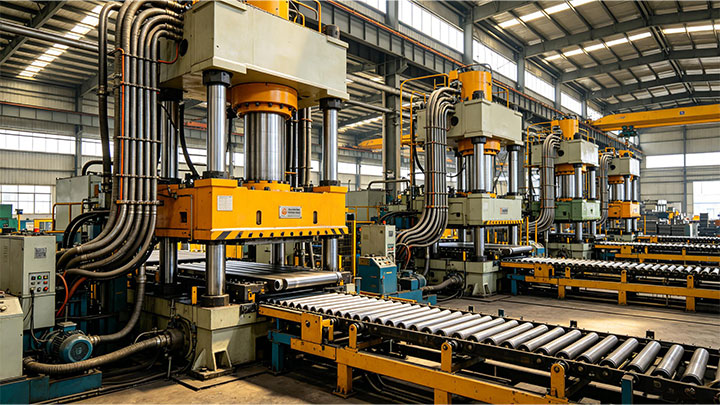
Structural features: A closed load-bearing frame is composed of a welded or cast base, four parallel chrome plated guide columns, a moving template (slider), and an upper crossbeam fastened with nuts/locking rings. The moving template is guided in a straight line along the four guide columns, and the press fit center is located at the geometric center of the four columns. When subjected to force, the body mainly undergoes axial compression deformation rather than bending and opening deformation, so its ability to resist eccentric loads is significantly better than that of the C-type. The workbench has a large area (commonly ranging from 400 × 400mm to 1000 × 800mm) and can be used to install multi station molds or large fixtures. Some models have movable templates with T-shaped slots for quick mold replacement. The travel distance is usually 150-500mm, and the opening height can be adjusted within a wide range. Advantages: high rigidity, high parallelism (the guiding accuracy of the guide column ensures that the parallelism between the moving template and the worktable is ≤ 0.03mm), suitable for large-area molds and processes with small offset loads; Disadvantage: The surrounding enclosure requires a dedicated slide table for loading and unloading from top to bottom or from the side, which takes up a large area and incurs high costs. Applicable: Large automotive component assembly pressing (such as sub frame liner pressing, differential housing assembly), motor stator and rotor pressing, powder metallurgy product shaping/pressing, composite material lamination, rubber parts vulcanization pre pressing, processes requiring multi-point uniform pressure distribution. The rated force range is 20-2000kN (2-200tf), and for large tonnage, proportional/servo hydraulic assistance can be selected, but the main pressure is still executed by the servo electric cylinder.
3、 Desktop/Mini Servo Press
Structural features: Ultra compact C-type or column type micro frame, with an overall width often less than 400mm, can be placed on experimental or assembly line workbenches, integrated touch screen (sometimes the screen body and electronic control are combined), rated pressing force of 0.5kN, 1kN, 2kN, 5kN (50-500kgf), stroke usually 50-100mm, pressing speed of 0.1-50mm/s infinitely adjustable. Advantages: Extremely low purchase and land occupation costs, plug and play (single-phase 220V or three-phase 380V), suitable for research and development trial production/laboratory/small batch high-precision assembly. Applicable: Micro bearing/gemstone bearing press fit, connector pin press fit, PCB board component press fit, sensor calibration loading, teaching demonstration, and new product process development. This model also has the functions of force displacement curve recording and OK/NG judgment, making it an ideal tool for process validation.
Selection principle: Workpiece diameter ≤ throat depth and single point center load priority C-type (with the highest cost-effectiveness); The workpiece is large or requires partial load bearing/multi-mode priority four column type; Research and develop prototypes or select desktop models for ultra precision pressing of small items. The same tonnage C-type and four column type can share control cabinets and software platforms, facilitating unified data management at different workstations in the same factory.