




PUMO CNC Machine Tool Spindle - Working Principle and Analysis of "Zero Drive" Electric Spindle Technology
The working essence of PUMO CNC machine tool spindle is to convert electrical energy into controlled mechanical rotational motion, and transmit this rotational motion to the cutting process through the tool or chuck. For the most common variable frequency/servo driven spindle systems, the CNC controller sends speed/torque commands to the spindle drive based on the user written machining program (S command sets speed, M03/M04 sets direction) - early systems often used 0-10V analog signals, while modern high-end systems transmit commands through serial fiber or industrial Ethernet (FANUC Serial Spindle, SIEMENS Drive CLiQ, EtherCAT, etc.) digital communication. The spindle drive (VFD frequency converter or vector control servo drive) outputs three-phase AC power of corresponding frequency according to instructions to drive the spindle motor to rotate. The motor magnetic field acts on the squirrel cage rotor (asynchronous spindle) or permanent magnet rotor (synchronous servo spindle), generating electromagnetic torque to drive the spindle shaft system to rotate.
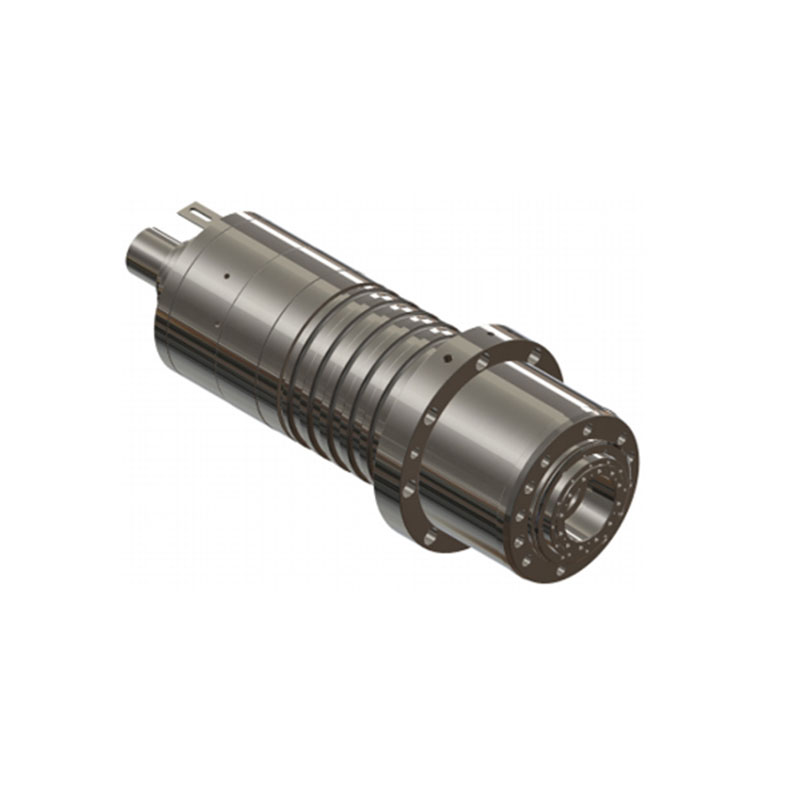
In belt or gear driven main shafts, power is transmitted between the motor and the main shaft through belt pulleys for deceleration/acceleration or gearboxes, resulting in elastic sliding, meshing clearance, and additional moment of inertia; In PUMO electric spindle (built-in motor spindle), a "zero transmission" architecture is adopted - the stator core is pressed into the housing with a circulating cooling water jacket through interference fit, and the rotor is directly fixed to the spindle neck through hot fitting or interference fit. The spindle is both the motor shaft and the cutting tool installation shaft, with no mechanical transmission link in between. This design minimizes transmission chain losses (transmission efficiency>95%), eliminates vibration and noise introduced by belts/gears, greatly improves low-speed torque stability and high-speed rotation accuracy, and significantly reduces acceleration and deceleration time due to the significant reduction in moment of inertia (0 → maximum speed is usually completed within 1-4 seconds).
The PUMO electric spindle is equipped with a non-contact rotary transformer or high-resolution absolute encoder (2048~8192 lines and above), which can provide real-time feedback on the spindle angle position. It not only supports basic speed closed-loop control (ASC - Auto Spindle Control), but also supports: ① spindle orientation stop (Orientation) - used for precise positioning of tool changing positions; ② Rigid Tapping - The spindle and Z-axis are strictly synchronized to ensure pitch accuracy; ③ C-axis contour control - the spindle rotates and the feed axis participates in interpolation in the turning and milling composite machine tool; ④ Constant line speed cutting (G96) - In turning, the speed is automatically adjusted to maintain a constant cutting line speed as the workpiece diameter changes. For permanent magnet synchronous servo spindles with vector control, constant torque output can be maintained below the base speed (suitable for low-speed heavy cutting of threads and square shoulder milling), and above the base speed enters the constant power zone (suitable for high-speed precision machining). The power speed torque characteristic curve is the core basis for selection.
Thermal management is the key to the reliable operation of the electric spindle: the PUMO electric spindle housing is equipped with spiral or axial cooling channels, and an external constant temperature chiller (usually set at 20-25 ℃) is used for forced circulation to remove stator copper loss, rotor iron loss, and bearing friction heat, controlling the thermal elongation of the spindle at the μ m level; The front and rear bearings are lubricated with Oil Air Mist or long-lasting high-temperature grease to ensure that the dn value (bearing inner diameter mm x speed rpm) is within the allowable range for long-term operation. Some high-end models have built-in PT100/PT1000 temperature sensors and vibration acceleration sensors in the front cover, which can provide overheating, abnormal vibration alarms, and life warnings through drivers or independent monitoring modules, providing data support for predictive maintenance.