




PUMO CNC machine tool spindle - application of CNC lathe, turning milling composite and Y-axis power turret
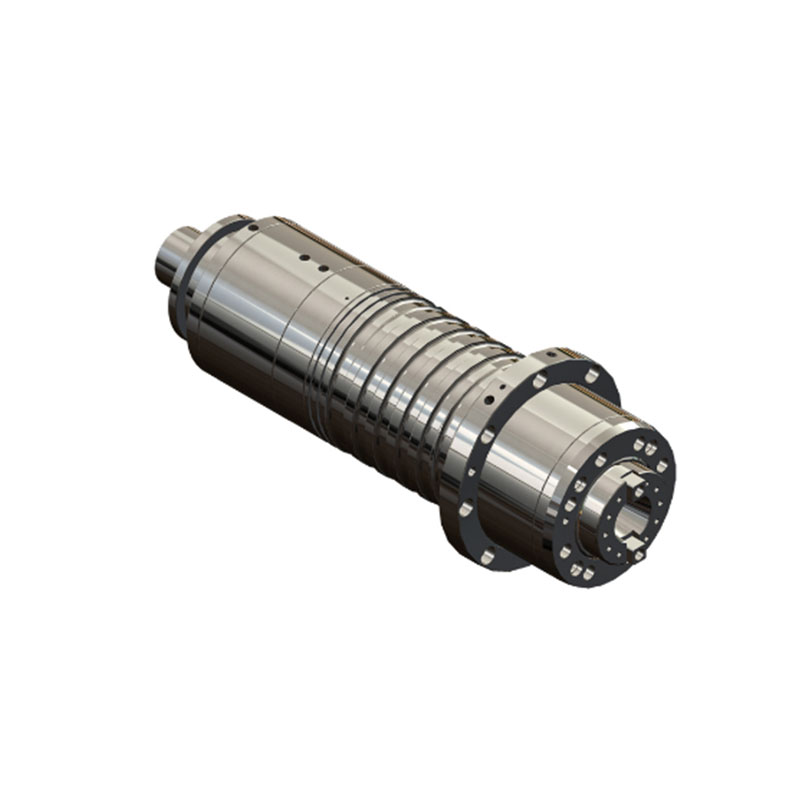
The main spindle (workpiece axis) of a CNC lathe and the main spindle (tool axis) of a machining center have different functional roles: the former holds and rotates the workpiece, requiring a large hole to pass through the bar material, high radial/axial rigidity to withstand cutting forces, C-axis positioning tapping, and power milling. The PUMO lathe spindle unit adopts a high rigidity double support structure. The front support is a multi link angular contact ball bearing that is preloaded back to back to bear the main radial and rightward axial forces. The rear support floats to allow thermal expansion. The spindle through-hole is φ 52/φ 62/φ 80/φ 102mm (corresponding to A2-5/A2-6/A2-8 nose end and 5 "/6"/8 "chuck), and the hydraulic rotary oil cylinder drives the three jaw chuck or spring chuck. The clamping force can be adjusted by a pressure reducing valve and switched according to the process in the program (coarse main jaw force, fine main jaw moderate or soft jaw correction).
PUMO servo spindle motor drive enables the lathe spindle to have C-axis contour control function - spindle orientation stop accuracy ≤ ± 0.01 ° (with external index pin up to ± 0.001 °), combined with power turret (Y-axis power head), can complete radial/axial eccentric hole drilling, keyway milling, polygon machining and spiral interpolation milling, achieving "turning milling composite" in one machine. In the rigid tapping mode, the spindle and Z-axis are strictly synchronized to ensure the accuracy of the internal thread pitch and diameter, without the need for compensating shims. Some high-end models are equipped with a sub spindle/secondary spindle, which is aligned with the main spindle to perform back working. The PUMO sub spindle can be the same size or slightly smaller than the main spindle, and supports synchronous speed tracking to achieve part transfer and drilling/tapping/turning of the back end face.
The inclined bed CNC lathe often uses PUMO belt drive or direct servo spindle: the belt type can be adjusted by the pulley ratio - the large driving wheel and small driven wheel achieve high speed, suitable for high-speed turning of non-ferrous metals (up to 3500-4500rpm), and vice versa, achieve high torque, suitable for deep cutting of steel parts (the minimum continuous speed can be as low as 30-50rpm to maintain sufficient cutting torque without "crawling"). The built-in Motorized Lathe Spindle directly installs the rotor onto the spindle and stator housing, removing the belt/pulley. The maximum speed can reach 5000-6000rpm without belt maintenance issues, making it suitable for high-end turning and milling composite centers.
For the automatic feeding machine of bar materials, the PUMO spindle through-hole can be penetrated into the guide tube and push rod, and the rear support is equipped with a labyrinth seal and air blowing to prevent iron filings from entering the bearing chamber. When selecting the center outlet rotary joint, attention should be paid to the maximum working pressure and sealing type (mechanical seal or magnetic fluid seal). PUMO can provide complete installation flange dimension drawings, hydraulic chuck matching tables, calculation of thrust and tension of rotary oil cylinders, and definition of C-axis encoder wiring for lathe spindles, facilitating electrical and hydraulic design of the entire machine.