




PUMO servo press - application in the new energy (lithium battery/drive motor/electronic control) industry
The precision assembly of the three electric systems (battery, motor, electronic control) and supporting components of new energy vehicles highly relies on the process monitoring capability of servo presses. PUMO has formed mature application cases in this field:
Assembly of power battery (lithium-ion/solid-state):
① Stacking Preloading of Cells - Before inserting square aluminum shell cells into the module frame, a servo press should be used in the fixture to apply uniform preload force in a constant force mode (such as 3000-8000N according to the module design) to eliminate gaps between cells. The force control accuracy is ± 1% FS to ensure that each cell is evenly stressed without internal damage caused by compression. The pressure should be maintained until the side plate is welded or tied tightly; The pressure head area matches the module cross-section and is equipped with a parallelism calibration plate to ensure uniform distribution.
② Busbar/collection harness FPC crimping - Nickel or copper aluminum composite Busbar needs to be crimped with insulation cover or locking auxiliary compression after ultrasonic welding with pole. PUMO uses position mode small stroke pressing to confirm that the buckle is in place, and the force displacement curve can detect abnormal deformation of Busbar.
③ Sealing gasket pressing and bolt pre tightening assistance for battery pack upper cover - some processes use large-area pressure heads to press the upper cover with low constant force (anti crushing sealing strip) while tightening the surrounding bolts to ensure consistent sealing compression.
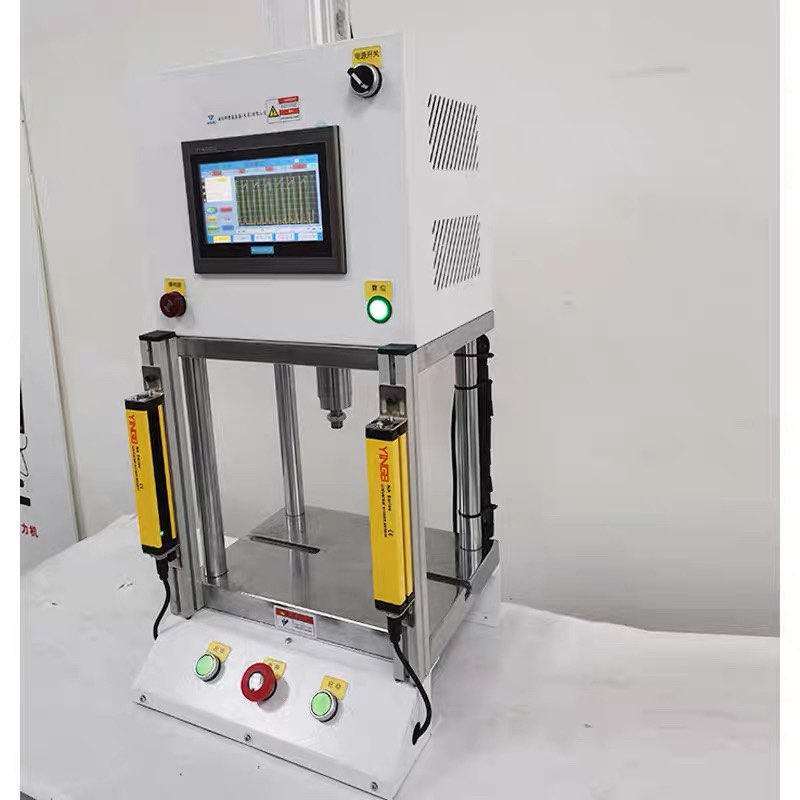
④ Explosion proof valve/injection port component press fit - small force value (several hundred newtons) precision press fit to prevent shell deformation, using a 2-5kN desktop type with a fine adjustment platform.
Drive motor (drive motor stator rotor press fit):
① Rotor core lamination and shaft pressing installation - The rotor laminations of permanent magnet synchronous motors are first laminated into sections (sometimes heated for interference fit), and then the shaft is pressed into the inner hole of the rotor core using a servo press. The position mode controls the pressing depth to ensure the axial symmetry of the permanent magnet. The force displacement curve monitors the different slopes of the lamination section and the shaft section to distinguish the friction and interference fit characteristics of the laminations;
② Stator core press fit into housing - the outer diameter of the stator is in interference fit with the inner hole of the motor housing. It is a four column large tonnage (100-300kN depending on the size of the housing) press fit, equipped with two processes: heating (preheating the housing to 80-120 ℃) or room temperature press fit. PUMO can output a heating start signal to link with the temperature control cabinet;
③ Bearing and oil seal press fit (front and rear end caps) - Same as the automotive bearing press fit process, but needs to be integrated with the motor assembly line for automatic loading and unloading.
Electronic control and vehicle electronics: IGBT modules are crimped with heat dissipation substrates (pressure distribution needs to be controlled evenly, sometimes equipped with multiple sensors or pressure plates), capacitor pins are pressed into PCBs, connector housings are pressed, etc. C-type 5-20kN models are often used with anti-static countertops.
Special requirements response: When there are explosion-proof zoning requirements in the battery workshop, PUMO can provide explosion-proof servo presses (Ex d IIB T4 Gb or Ex ib level, servo drivers and electrical cabinets are isolated and arranged, on-site buttons and grating intrinsic safety type); The clean workshop requires the use of electrostatic dissipation materials sprayed on the outer surface of the entire machine, or a stainless steel shell with food grade lubricating grease; Upload MES data in accordance with GB/T 34015 or customer CSR requirements, including barcode, timestamp, and force displacement raw data points (optional simplified upload to save bandwidth).