




Comparison of three mainstream forms of PUMO CNC machine spindle: belt drive, direct drive, and electric spindle
PUMO CNC machine tool spindles are divided into three categories according to power transmission methods, which are adapted to different processing requirements:
1、 Belt Driven Spindle
Structure: The independent spindle motor drives the tail pulley of the spindle through a multi wedge belt (PK belt) or V-belt and a pair of pulleys. The pulleys are connected to the spindle through a overrunning clutch or key, and the spindle is supported by precision angular contact ball bearings at the front and rear. Advantages: ① The speed torque matching can be flexibly adjusted by changing the ratio of the number of belt teeth (the large belt pulley decelerates to obtain high torque, suitable for rough milling of steel parts; the small belt pulley accelerates to obtain high speed, suitable for precision milling of aluminum parts); ② The motor can be installed independently away from heat sources and vibration zones; ③ Simple structure, low cost, and easy maintenance (just replace the belt). Disadvantages: The belt drive has elastic sliding, which causes the speed to fluctuate at extremely low speeds. The maximum speed is usually limited by the belt line speed, which is usually ≤ 8000-10000rpm, and introduces some noise. Applicable: Universal vertical/horizontal machining centers, CNC milling machines, mid-range mold machines, meeting the medium speed requirements for both rough and precision machining. Typical specifications of PUMO: BT40 spindle, 7.5/11kW motor, maximum 6000rpm or 8000rpm (variable ratio pulley can reach 10000rpm optional), torque of 70-120N · m.
2、 Direct Drive/Coupled Spindle
Structure: The output shaft of the servo/asynchronous spindle motor is directly connected to the tail flange of the spindle through a diaphragm or a plum blossom elastic coupling, without intermediate deceleration increase/decrease. Advantages: ① No belt sliding error, better low-speed stability than belt type; ② The coupling can absorb a small amount of coaxiality deviation and has overload protection; ③ Short transmission chain, good rigidity, and lower noise than belt transmission; ④ Usually, it can support higher maximum speeds (8000-12000rpm is common, 15000rpm requires special design). Disadvantage: The coaxial installation of the motor and spindle occupies a large axial space and cannot achieve flexible speed ratios like belt type (fixed 1:1 or nearly 1:1). Applicable: High speed, high rigidity, and excellent low-speed stability are required for mid to high end machining centers, especially for models that require high precision in rigid tapping and C-axis orientation. Typical specifications of PUMO: BT40/BT50 direct spindle, 11/15/18.5kW servo spindle motor, maximum 8000-12000rpm, torque 100-235N · m.
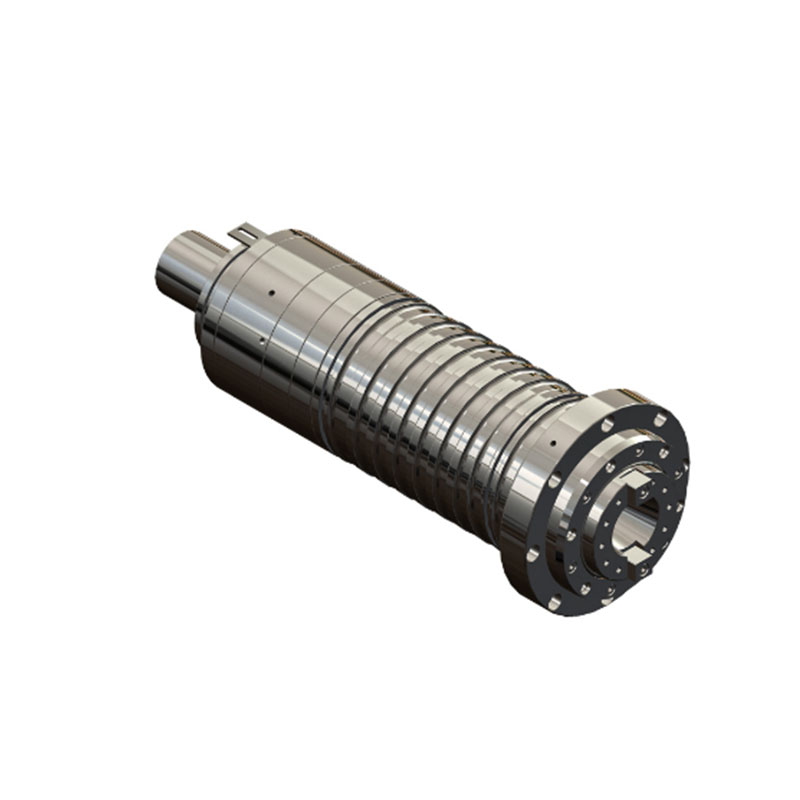
3、 Motorized/Built in Spindle
Structure: "Zero transmission" - stator embedded shell, rotor hot installed spindle, front end equipped with HSK or BT taper hole, automatic loosening knife, circulating water cooling, oil and air lubrication. Advantages: ① Extremely high maximum speed (common electric spindles used in machining centers are 15000/18000/24000rpm, while carving and milling/PCB can reach 40000~60000rpm); ② No intermediate transmission error, highest rotational accuracy (radial runout ≤ 0.002mm), and minimal vibration; ③ Fast acceleration and deceleration, low inertia; ④ Compact structure saves machine space. Disadvantages: Higher cost compared to the previous two methods, requiring high-frequency drivers and chillers, and requiring return to the factory for maintenance (bearings are permanently preloaded and cannot be replaced on site, generally requiring overall repair). Applicable: High speed machining centers (HSM), five axis linkage machining centers, high-speed milling of aviation aluminum parts, high gloss machining of molds, engraving and milling machines, PCB drilling/milling machines. The PUMO electric spindle series is subdivided by application: machining center type (HSK-A63, 18000-2400rpm, 7.5-15kW), engraving and milling type (ER20/ER25 chuck, 24000~36000rpm, 1.5~5.5kW), PCB drilling hole type (air floating/high-precision, 60000~100000rpm, low power).
Selection suggestion: heavy cutting steel parts/high torque priority belt or direct large torque spindle; Aluminum alloy/graphite/high gloss processing pursues surface quality and chooses electric spindle; Balancing cost and performance, choose belt or direct connection for universal processing. If there are multiple process requirements for the same machine tool, a dual spindle configuration or an electric spindle with a wide constant power range can be considered.